Some of the most important blues records ever made were pressed beside the Milwaukee River in Grafton, in a factory that also made chairs. The story of Grafton Paramount Records is one of the strangest and most consequential in American music: a Wisconsin furniture company, trying to sell phonograph cabinets, ended up recording Charley Patton, Son House and Ma Rainey, and laid down a body of work that the blues, and everything the blues fed into, was built on. The studio is long gone. But the town has not let the story disappear, and it is worth an hour of any visit to understand what happened here.
What is Grafton's Paramount Records history?
Paramount Records began in 1917 as a sideline of the Wisconsin Chair Company, which built phonograph cabinets in Grafton and reasoned that people who bought the cabinets would need records to play on them. The logic was commercial and a little absurd, and it produced something nobody planned. By the late 1920s Paramount had become one of the most important recorders of Black American music in the country. Between 1929 and 1932 alone, more than 1,600 titles were recorded in Grafton, roughly a quarter of all the blues, jazz and gospel records made in the United States during those years. The pressing plant stood on the river, whose water helped power it, and it employed hundreds of people at its peak.
Then the Depression arrived. Record sales collapsed, the label closed in 1932, and the building was demolished in 1938. For decades the whole thing was nearly forgotten, remembered mainly by collectors who paid extraordinary sums for the surviving 78s. The rediscovery came slowly: record dealer John Tefteller uncovered a trove of the label's original advertising art, and in 2013 the musician Jack White, whose family had ties to the Paramount operation, released an elaborate boxed set that digitised hundreds of the recordings and put the label back in front of a modern audience. That the music survived at all, and that Grafton now marks where it was made, is the reason this history is visitable rather than merely lost.
The artists who recorded in Grafton
The names still carry weight. Charley Patton, often called the father of the Delta blues, recorded here, as did Son House, whose playing ran straight through to Robert Johnson and, later, to rock and roll. Skip James, Ma Rainey, Blind Lemon Jefferson and Blind Blake all cut records in Grafton, along with gospel singers, jazz bands and Wisconsin dance outfits. Most of the Southern artists made an improbable journey to get here: recruited in places like Jackson and Birmingham, given money for the train, they travelled north to Milwaukee, stayed in boarding houses there, and rode the interurban rail line out to Grafton to record before heading home.
It is worth sitting with how unlikely the geography was. The blues was Southern music, born in the Mississippi Delta and the juke joints along it, and yet a great deal of it was first captured on wax in a small Wisconsin town most of the musicians had never heard of. Paramount's talent scouts, working on tips from record dealers in the South, would sign an artist in Mississippi or Alabama and send them north to a place they knew nothing about, to record in a factory owned by a chair company.
One story catches the whole arc. Henry Townsend, the last surviving blues artist who had recorded for Paramount, died in Grafton on a return visit in September 2006, just hours after being honoured on the newly unveiled Walk of Fame. He had come back to the town where he made records as a young man, seventy years on, to see it finally remember them.
Paramount Plaza and the Walk of Fame
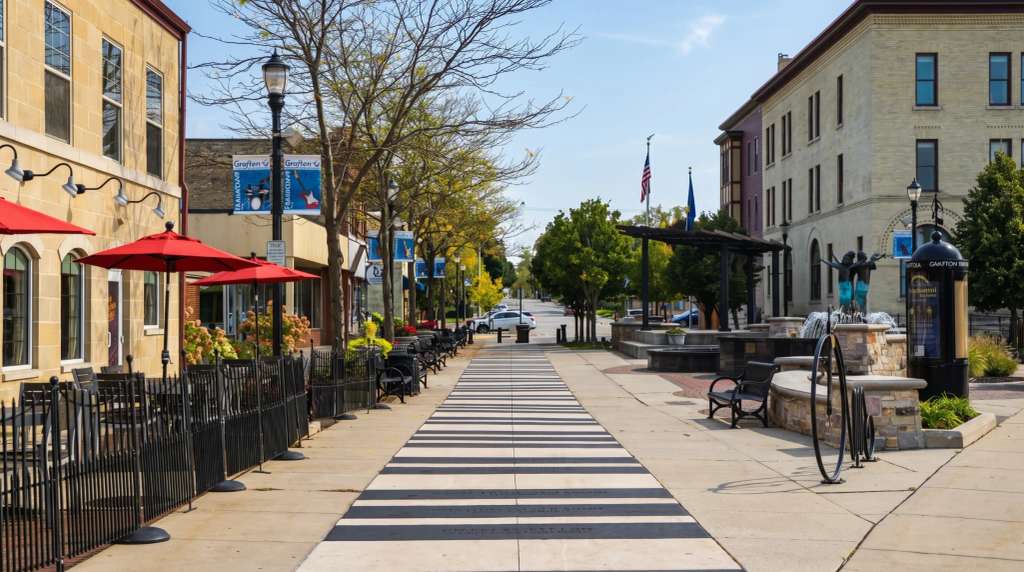
What you can actually see today sits downtown at 1304 12th Avenue. Paramount Plaza, established in 2006, marks the label's legacy with a fountain and a Walk of Fame: a stretch of sidewalk laid out to look like a piano keyboard, its black-granite "keys", each about two feet by seven, inscribed with the names of artists who recorded for Paramount. The Village adds new keys over time, so the walk grows. It is free, open, and takes only a few minutes to walk, but knowing what you are looking at changes it entirely.
Be honest with your expectations before you go: the studio itself is gone, and this is a plaza and a sidewalk, not a museum with exhibits behind glass. What it offers is the fact of standing where it happened, in the actual town, a short walk from where the plant stood on the river. For a certain kind of visitor, that is more than enough.
The self-guided walking tour
To get more than the plaza gives, pick up the free self-guided walking-tour booklet at the Grafton Library or the Chamber of Commerce. The route runs about half a mile through downtown and describes the area as it was during the Paramount years, tying the plaza back to the river, the rail line and the vanished plant. It takes maybe half an hour at a slow pace, and it is the difference between glancing at a sidewalk and actually reading the town. The plant itself stood near where 12th Avenue meets the river, so the walk puts the plaza, the water that powered the presses, and the rail line the artists rode in on into a single frame.
Where the story lives on around town
The history is not sealed off in the plaza; it surfaces around Grafton if you know to look. The clearest example is a beer. Sahale Ale Works, the independent brewery downtown, pours a Paramount Stout named directly for the label, and it is a good place to sit with the story after you have walked the plaza.
The creative thread runs on from there. The galleries and maker studios of the Arts Mill keep a working-artist culture alive in an old mill building of exactly the kind that gave the town its industry a century ago.
There is a living side to it too. The Grafton Blues Association, founded in 2006, has kept the label's memory in circulation with the annual Paramount Blues Festival, which brings the music back to the town that made it. A lot of that history still gets talked over a pint in Grafton's breweries and taprooms, Sahale's Paramount Stout being the obvious place to start.
Making a day of it
Paramount Plaza is a stop, not a day, so build the rest of a visit around it. Lunch downtown is minutes away, with the town's lunch a short walk from the plaza a short walk from the plaza.
From there the Milwaukee River, the parks, and the whole the rest of a day in town open up. The blues history is the reason Grafton is unlike any other small town its size; the rest of what is here is the reason to stay past the plaza.
Frequently asked questions
Published September 8, 2026